Industrial Stainless steel conical fermenters are essential vessels used in modern brewing, winemaking, distilling, food processing, biotechnology, and other controlled fermentation environments. Built for durability, sanitation, temperature stability, and efficient yeast or sediment handling, these tanks are designed to support high-volume production while maintaining consistent product quality. For businesses searching for reliable fermentation equipment, understanding the applications, structure, benefits, and technical specifications of an industrial stainless steel conical fermenter is the first step toward selecting the right vessel for a production line.
This guide provides SEO-friendly, industry-focused information about stainless steel conical fermenter applications, including definitions, common uses, functional advantages, standard specifications, and process considerations. The content is written in clear English and formatted for direct use in blogs, category pages, product collection pages, or industry landing pages.
What Is an Industrial Stainless Steel Conical Fermenter?
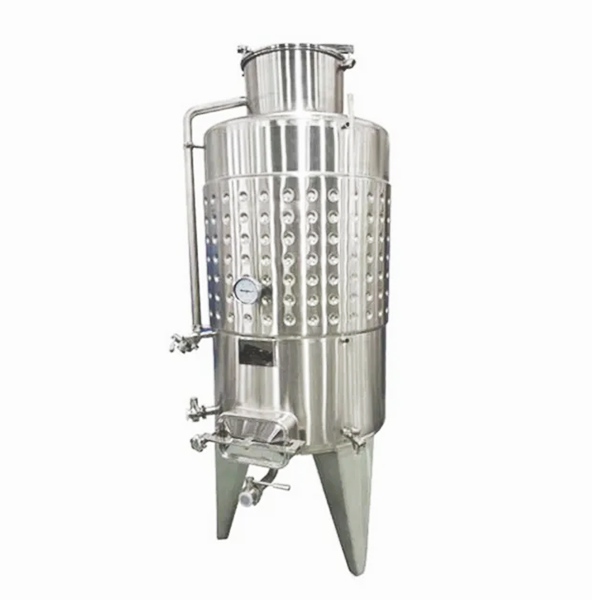
An industrial stainless steel conical fermenter is a Fermentation Tank with a cone-shaped bottom designed to collect yeast, solids, sediment, or lees during the fermentation process. The conical base makes it easier to separate liquid product from unwanted byproducts without excessive waste or contamination. These fermenters are widely used in industries that require controlled fermentation, sanitary design, and efficient downstream handling.
Stainless steel is the preferred material because it offers excellent corrosion resistance, easy cleaning, long service life, and compatibility with sanitary production environments. In industrial operations, conical fermenters are often fitted with cooling jackets, pressure-rated lids, manways, valves, sampling ports, CIP systems, and level indicators to improve process control and operational efficiency.
Why Stainless Steel Is the Preferred Material for Fermenters
Stainless steel is one of the most widely used materials for industrial Fermentation vessels because it combines strength, hygiene, and long-term durability. Unlike plastic or lower-grade metal alternatives, stainless steel can handle repeated cleaning cycles, temperature changes, pressure variations, and aggressive sanitizing agents without degrading performance.
- Corrosion resistance: Stainless steel performs well in wet, acidic, and sanitary environments.
- Sanitary surface: Smooth internal finishes reduce residue buildup and help prevent contamination.
- Durability: Industrial-grade tanks are built for long-term use under demanding production conditions.
- Easy cleaning: Stainless steel supports CIP cleaning and sterilization workflows.
- Temperature stability: Compatible with cooling jackets and thermal control systems.
- Professional appearance: Clean, modern, and suitable for visible production areas.
Core Applications of Industrial Stainless Steel Conical Fermenters
The applications of industrial stainless steel conical fermenters extend across multiple sectors. While the design is most commonly associated with brewing, it is also used in other fermentation-based production systems where separation, sanitation, and process consistency are important.
One of the most common applications of a conical fermenter is in beer production. During fermentation, yeast converts sugars into alcohol and carbon dioxide. As fermentation ends, yeast and trub settle at the conical bottom, making it easier to remove solids without disturbing the finished beer.
Industrial stainless steel conical fermenters are used for:
- Primary fermentation of ales, lagers, stouts, and specialty beers
- Secondary fermentation and maturation
- Yeast Harvesting and reuse
- Cold crashing and clarification support
- Controlled fermentation in craft, commercial, and large-scale breweries
2. Wine Production
In wine making, conical fermenters help manage skins, seeds, lees, and other solids. The vessel geometry supports easier separation and cleaner product transfer. Stainless steel construction also preserves wine quality by reducing exposure to unwanted contaminants and enabling precise temperature control.
- Red wine fermentation
- White wine fermentation
- Skin-contact maceration processes
- Lees separation and sediment removal
- Temperature-controlled fermentation for aroma protection
3. Distilling and Spirit Production
Distilleries use stainless steel conical fermenters to prepare wash or mash before distillation. The conical bottom simplifies sediment separation, while stainless steel ensures sanitary handling of fermentation materials. These vessels are especially useful in grain-based, fruit-based, and sugar-based spirit production.
- Whiskey wash fermentation
- Rum fermentation
- Vodka mash preparation
- Fruit spirit fermentation
- Yeast and solid removal prior to distillation
4. Food and Beverage Processing
Industrial fermenters are used in food production for products that rely on microbial activity, controlled acidity, or flavor development. Stainless steel conical tanks are suitable for operations requiring hygienic processing and precise quality control.
- Kombucha fermentation
- Vinegar production
- Fermented sauces and condiments
- Dairy fermentation applications
- Probiotic beverage production
5. Biotechnology and Industrial Fermentation
Beyond beverage production, conical fermenters can be used in biotechnology and industrial fermentation processes involving microbial cultures, enzymes, or biochemical production. In these environments, sanitary vessel design and process consistency are critical.
- Microbial culture propagation
- Bioprocess fermentation
- Enzyme production
- Controlled laboratory-to-pilot scale fermentation
- Research and development applications
The cone-shaped bottom is the defining feature of a conical fermenter. This geometry improves separation efficiency and supports cleaner, more controlled production. The design provides practical benefits in both small and industrial-scale operations.
Advantage |
Description |
Production Benefit |
|---|
Efficient sediment removal |
Solids settle into the cone naturally |
Cleaner liquid transfer and less waste |
Better yeast management |
Yeast can be collected or removed from the bottom |
Improved fermentation control and possible yeast reuse |
Reduced contamination risk |
Minimal disturbance during draining and harvesting |
Higher product consistency and sanitation |
Improved clarity |
Solids settle naturally and separate more easily |
Clearer final product with less filtration demand |
Process flexibility |
Suitable for many industries and product types |
Multi-purpose use in fermentation lines |
These benefits make conical fermenters especially valuable where separation, hygiene, and consistent batch performance are priorities. For high-volume manufacturing, the ability to remove sediment efficiently can reduce labor time and improve operational throughput.
Typical Components of an Industrial Stainless Steel Conical Fermenter
Industrial conical fermenters may vary in configuration depending on production requirements, but most include several standard features that support safe, sanitary, and efficient fermentation.
Component |
Function |
|---|
Conical bottom |
Collects sediment, yeast, and solids for easy separation |
Cylindrical body |
Provides main fermentation volume |
Cooling jacket |
Helps maintain stable fermentation temperature |
Manway |
Allows access for inspection, cleaning, and maintenance |
Pressure relief valve |
Protects vessel from excess pressure buildup |
Sample port |
Supports quality testing during fermentation |
Drain valve |
Enables product transfer and sediment removal |
Level indicator |
Helps monitor fill volume and process control |
CIP spray ball |
Supports clean-in-place sanitation |
Insulation layer |
Improves temperature retention and energy efficiency |
Standard Specifications for Industrial Stainless Steel Conical Fermenters
Specifications can vary widely depending on the intended use, tank capacity, and process requirements. The table below shows common industrial specification ranges for general reference.
Specification |
Common Range |
Notes |
|---|
Material |
Stainless steel 304 or 316 |
316 is often used for more demanding corrosive environments |
Capacity |
100 L to 100,000+ L |
Depends on batch size and industry scale |
Finish |
Polished interior, brushed or polished exterior |
Sanitary finish is important for cleaning and hygiene |
Pressure rating |
Atmospheric to pressure-rated |
Used where fermentation pressure must be controlled |
Temperature control |
Optional cooling jacket |
Supports stable and repeatable fermentation conditions |
Cone angle |
Typically 60° to 90° |
Angle affects sediment collection and drainage performance |
Insulation |
Optional PU or similar insulation |
Improves thermal efficiency in industrial use |
Accessories |
Valves, ports, sensors, ladders, platforms |
Selected based on process needs |
How Industrial Conical Fermenters Support Production Efficiency
Industrial fermentation operations depend on speed, consistency, sanitation, and repeatability. Stainless steel conical fermenters help meet these goals by simplifying key steps in the process. Their design reduces the need for manual sediment handling and can improve batch turnaround time.
Efficient sediment collection means that operators can remove unwanted solids without transferring large amounts of liquid. This reduces product loss and decreases the amount of filtration required later in the process. In breweries and distilleries, it also helps with yeast recovery, which can lower operating costs and improve process planning.
Another efficiency advantage is temperature control. Fermentation is sensitive to heat, and even small variations can affect flavor, alcohol level, microbial activity, and final yield. Cooling jackets and insulation help maintain consistent conditions, which supports better batch uniformity and reduced production risk.
Hygiene and Sanitation Benefits
Sanitation is one of the most important reasons industries choose Stainless steel fermenters. Fermentation vessels must be easy to clean and resistant to residue buildup because any contamination can affect flavor, quality, or safety.
- Smooth internal surfaces reduce microbial hiding points
- Stainless steel withstands repeated sanitation cycles
- CIP systems reduce labor and cleaning downtime
- Sanitary fittings help maintain product purity
- Proper drainage prevents trapped residue and standing liquid
In food, beverage, and biotechnology applications, these hygiene advantages are especially valuable. A sanitary fermenter helps ensure that each batch begins in a controlled environment and finishes with minimal risk of cross-contamination.
Common Size and Scale Categories
Industrial stainless steel conical fermenters are available in multiple sizes to fit different production requirements. The correct size depends on batch frequency, target output, available floor space, and process design.
Scale |
Typical Capacity |
Common Use |
|---|
Pilot scale |
100 L to 1,000 L |
Research, product development, small-batch testing |
Small industrial scale |
1,000 L to 5,000 L |
Craft production and growing commercial operations |
Medium industrial scale |
5,000 L to 20,000 L |
Regional production and regular batch manufacturing |
Large industrial scale |
20,000 L and above |
High-volume commercial and process manufacturing |
Important Factors When Selecting a Conical Fermenter
When evaluating industrial stainless steel conical fermenters, buyers should focus on process compatibility rather than appearance alone. The right vessel should match product type, batch volume, cleaning workflow, and temperature requirements.
- Product type: Beer, wine, spirits, food, or biotech media may require different features.
- Tank capacity: The vessel should fit current output and future growth plans.
- Material grade: 304 and 316 stainless steel are common, but not always interchangeable.
- Pressure needs: Some applications require pressure-rated designs.
- Temperature control: Cooling jackets may be essential for process stability.
- Sanitation method: CIP compatibility is a major operational advantage.
- Footprint: Height, diameter, and installation space must be considered.
- Access and maintenance: Manways and valves should support routine service.
Industrial Stainless Steel Conical Fermenter Applications Summary
Industrial stainless steel conical fermenters are versatile, sanitary, and efficient vessels used across brewing, winemaking, distilling, food processing, and biotechnology. Their cone-shaped bottom improves separation performance, supports cleaner transfers, and helps reduce waste. Stainless steel construction provides the durability, corrosion resistance, and hygiene required for demanding industrial environments.
Whether the goal is improved yeast handling, better sediment control, stable fermentation temperatures, or easier sanitation, a conical fermenter is a practical solution for controlled production systems. For industrial operations seeking a dependable fermentation vessel, stainless steel conical fermenters remain one of the most widely used and technically effective choices available.
Frequently Used SEO Keywords
Industrial stainless steel conical fermenter, conical fermenter applications, stainless steel fermentation tank, industrial fermenter, conical bottom fermenter, fermentation vessel, brewery fermenter tank, Wine Fermentation Tank, distillery fermenter, Sanitary Stainless Steel Tank, yeast separation tank, industrial fermentation equipment, stainless steel conical tank.
 +86 29-87031531





 Telefone
Comente
(0)